WRITTEN BY ARYN YOUNGLESS
October 25, 2026 marks the 50th anniversary of the Los Angeles City Historical Society — half a century of preserving, celebrating, and championing the rich and layered history of one of the world's great cities. To mark this milestone, we are publishing a series of articles exploring the people, projects, and stories that have shaped the Society since its founding in 1976. This is the first of those pieces: the story of the three men who started it all, and why what they built still matters today.
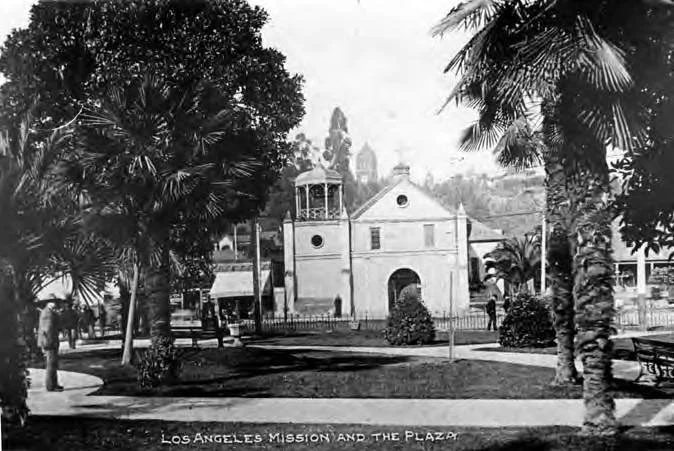
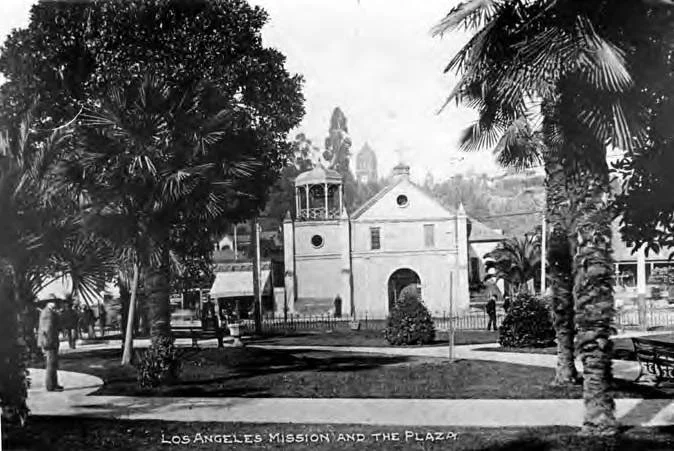
Los Angeles Plaza Church and Plaza | 1890 - California Historical Society | City of Los Angeles, El Pueblo Monument | via Tessa Los Angeles Public Library
There is a particular kind of civic devotion that asks nothing in return — no fame, no fortune — just the quiet conviction that a city’s story is worth preserving. In the early 1970s, three men shared that conviction, and from it they built something that continues to shape how Los Angeles understands itself — the Los Angeles City Historical Society.
Their names were William Mason, Paul de Falla, and Dr. Atilio Parisi. They recognized a gap in the cultural landscape of one of the world’s great cities. Despite the existence of regional and neighborhood historical societies in Southern California, no organization focused on the history of the original City of Los Angeles — the Pueblo from which everything else had grown.
They set out to fill that gap, and on October 25, 1976, the Los Angeles City Historical Society (LACHS) was incorporated with the State of California.
But LACHS was not the only institution these men helped bring into being. The mid-1970s marked a remarkable moment in Los Angeles History. Between 1976 - 1979, the Los Angeles County Library established four cultural centers: the American Indian, Asian Pacific, Black, and Chicano Resource Centers. The California African American Museum (CAAM) was established in 1977. Mason and de Falla were at the center of this movement, present not just at one founding, but several.
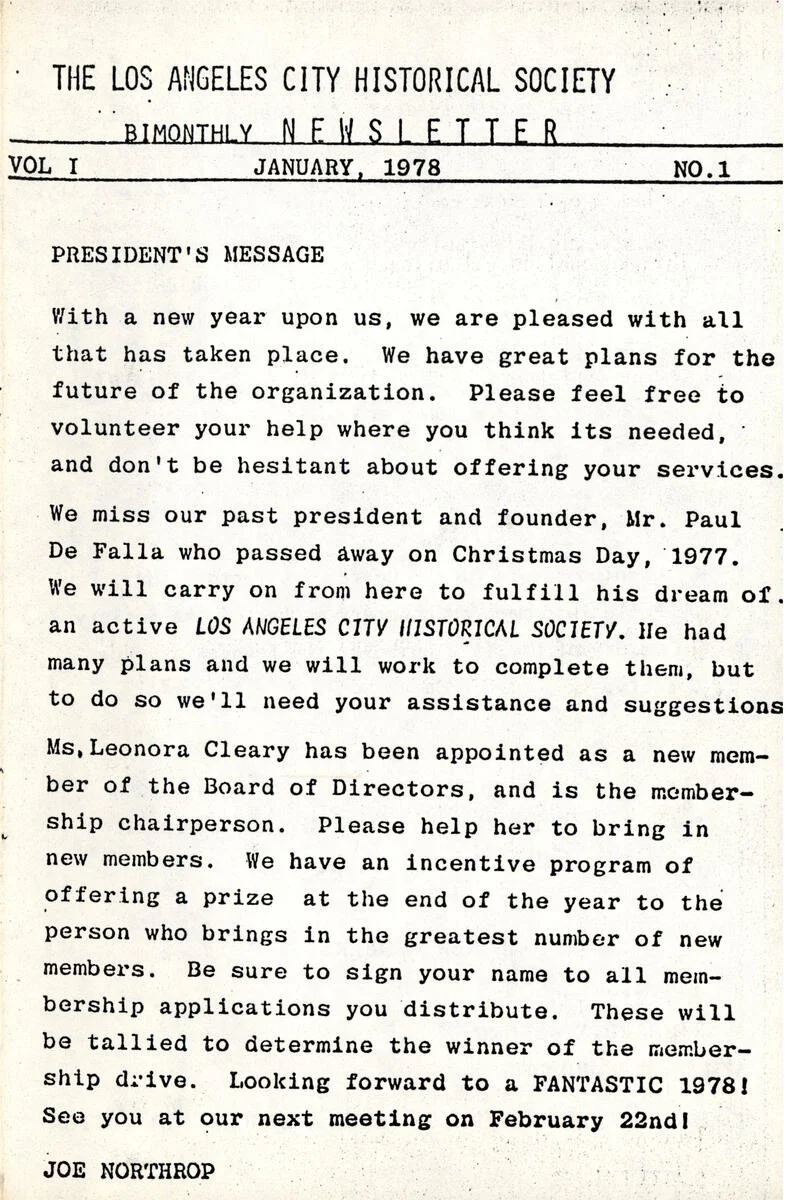
Los Angeles City Historical Society Newsletter - Issue One, 1978
From the start, the Society operated with modest means and large ambitions. Membership dues were first set at $7.50 per year, and a newsletter began publication a year and a half later in January 1978. Member Bill Boehner designed the Society’s logo, which encodes a quiet history lesson: it symbolizes both the original plots of land designated for the Mexican founders of the Pueblo and the successive seats of municipal authority — the Plaza Church, the old City Hall at Broadway and 2nd Street, and the present City Hall on Spring Street. In a single image, the entire arc of Los Angeles governance.
William M. Mason (1931–2000): The Historian Who Saw Everyone
William Mason was a native son of Los Angeles — born in the city, educated at UCLA, and devoted to explaining it for the rest of his life. Before he became a historian, he was a Marine. He served in the Korean War and earned a Purple Heart, though he later came to criticize American military intervention in both Korea and Southeast Asia. Whatever the war had done to his politics, it had not dampened his curiosity about the human record — and when he returned home, he turned that curiosity toward the city he had grown up in.
For 31 years, Mason served as curator of Southern California history at the Los Angeles County Museum of Natural History, retiring in 1993 but continuing to write and lecture until nearly the end of his life. From that position, he worked tirelessly to reshape not just how Los Angeles history was told, but who it was told about. He took the time to search for who, in the received histories of the 19th century, had been deliberately maligned or erased.
Mason’s most important argument was also his most fundamental — Los Angeles had been multiethnic from its very first day. In a September 1975 op-ed for the Los Angeles Times, he laid it out with characteristic precision — of the 44 original pobladores who founded Los Angeles in 1781, only two were white. Twenty-six had some degree of African ancestry; the remaining 16 were Indians or mestizos. He spent his career insisting that this founding reality mattered — that the city could not understand itself without it.
That conviction drove everything he did at the museum. Under his curatorial hand, the Natural History Museum produced a series of landmark exhibitions: “The Blacks of Los Angeles,” “The Japanese of Los Angeles,” and “The Chinese of Los Angeles” — each one an act of historical reclamation. In 1969, he curated the local sections of “America’s Black Heritage,” the first exhibition of its kind mounted by a major American museum. He also championed photographer Toyo Miyatake’s extensive documentation of the Manzanar internment camp, where thousands of Japanese Americans from Southern California had been held during World War II, helping to bring those images to public attention.
Mason was equally willing to challenge received mythology. For decades, popular accounts had portrayed 19th-century Chinatown as a labyrinth of underground tunnels — opium dens, gambling parlors, tong hideouts. Mason argued this was anti-Chinese scare propaganda, invented by a hostile press. He was vindicated in spectacular fashion when Metro Rail construction excavated the site of the original Chinatown near Union Station: no tunnels were found.
But Mason was not only a scholar and curator. He was also a passionate street photographer who regularly wandered the neighborhoods of Los Angeles with his camera, talking to residents and documenting the living texture of the city’s ethnic enclaves. His photographs of Little Tokyo — roughly 500 negatives and 162 prints from the 1960s — survive today as an invaluable archival collection.
Over his career, Mason wrote six books: The Census of 1790: A Demographic History of California; Modest Fortunes (with Donald Chaput and David Zarate); Early Dominguez Families and Settlement of the Rancho San Pedro; Adobe Interiors of Spanish California; Japanese of Los Angeles; and The Romero Expeditions (with Lowell Bean). He died on November 15, 2000, at the age of 69, survived by his wife, Wasana, and stepson Marvin in Thailand, and his daughter, Monica Davis, in Los Angeles.
His institutional reach extended beyond the Natural History Museum. On November 1, 1975 — the same year as his landmark Times op-ed, and just one year before co-founding LACHS — Mason was among the key attendees at the founding meeting of the Chinese Historical Society of Southern California, held at Cathay Bank in Los Angeles. It was a pattern that defined his career: wherever the history of an underrepresented Los Angeles community needed a champion, Mason showed up. In the year of his death, Mason received the Society's annual award for research and authorship — a final recognition from the institution he had helped build.
Paul de Falla: The Co-Visionary
Paul de Falla came to the work of history from an unexpected direction. By profession, he was a Deputy Sheriff of Los Angeles County — a career law enforcement officer who had worked plainclothes and investigative assignments and qualified in court as an expert witness on criminal operations. It is a background that, on the surface, seems a long way from founding historical societies. But in practice, decades of work in Los Angeles communities gave de Falla something the academic historians often lacked: a ground-level, street-by-street familiarity with the city, its neighborhoods, its record systems, and its bureaucratic machinery. When the time came to build institutions, he knew how things got done.
What makes de Falla’s contribution all the more striking is that LACHS was not his only founding effort in this period. On November 1, 1975, de Falla was also among the key attendees at the founding meeting of the Chinese Historical Society of Southern California, alongside Mason and Paul Louie. The two men were, in other words, partners in a broader movement — helping to build the institutional infrastructure for ethnic and municipal history in Los Angeles at the same moment, from multiple directions at once.
Together with Mason, he then conceived and drove the effort to establish LACHS. Beyond his law enforcement career and his founding roles, detailed biographical records of de Falla’s personal life have not surfaced prominently in the public historical record, which is perhaps fitting for a man who spent his working life documenting others. What is clear is that his partnership with Mason was the intellectual and organizational engine behind the Society’s founding, and that his commitment to Los Angeles history ran deep enough to help launch not one but two lasting historical institutions within a single year.
Dr. Atilio Parisi: The Indispensable Friend
Every great founding has someone who makes the practical possible. For Mason and de Falla, that person was Dr. Atilio Parisi — a long-time friend of both men who stepped in to help turn their vision into a legal and organizational reality. Parisi's contribution was not one of historical scholarship but of friendship, trust, and practical support at a critical moment. Without him, the incorporation of October 25, 1976, might have remained an aspiration rather than a fact.
Parisi had deep roots in Los Angeles academic life. He was a member of the first graduating class of the University of California Southern Branch — the institution that would become UCLA — where he served as class treasurer for the alumni administration. The "First Grizzly" class, as they called themselves, graduated at a moment when the university was still finding its footing, much as LACHS would be fifty years later. His doctoral degree came later, but the organizational instincts that made him an effective class treasurer in his youth were the same ones he brought to the LACHS founding in 1976.
Notably, both Mason and Parisi had UCLA connections — Mason was educated there, and Parisi graduated from its predecessor institution. That shared alma mater may well have been part of the bond that brought them together.
Like de Falla, Parisi has not emerged as a prominent figure in the publicly available historical record beyond these details. But the Society's own account of its founding credits him by name alongside its two principal historians — a recognition that the work of building institutions is never done by scholars alone.
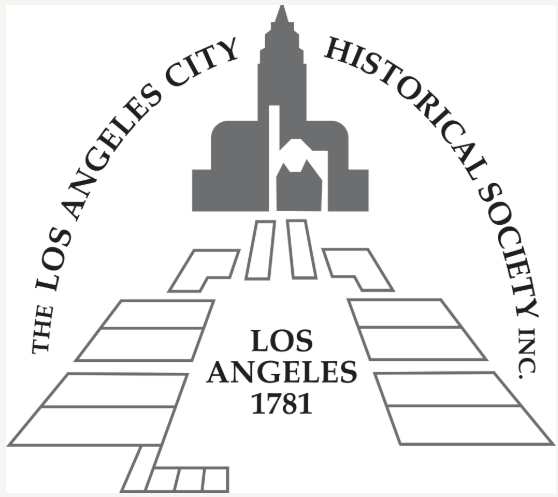
LACHS member, Bill Boehner, designed the Society’s logo — which encodes a quiet history lesson: it symbolizes both the original plots of land designated for the Mexican founders of the Pueblo and the successive seats of the municipal authority.
The Society’s Legacy
The Los Angeles City Historical Society was more than an idea. It was, from the moment of its founding, something historically singular — the first organization devoted solely to the history of the City of Los Angeles. From its earliest days, it undertook concrete projects that left permanent marks on the city.
One of the Society’s first acts was to mark the four corners of the original Pueblo in a lasting way. Joseph Northrop, the Society’s second president, was instrumental in carrying this work forward. Through sustained effort and advocacy, LACHS succeeded in placing commemorative plaques at each of the four historic points — now situated in what have become thoroughly modern settings: the northeast corner in Ernest S. Debs Park; the northwest near Sunset Boulevard at Fountain Avenue; the southeast near Olympic Boulevard at Indiana Street; and the southwest in Exposition Park. For anyone willing to seek them out, these plaques remain physical anchors connecting present-day Angelenos to the city’s 1781 founding.
In 1981, at the suggestion of genealogist Marie Northrop, the Society sponsored the creation of Los Pobladores 200, a heritage organization for descendants of the Pueblo’s original founders. Marie and her husband Joseph — himself a descendant of two founders’ families — compiled the necessary research and approached as many living descendants as they could find. It was a direct, living link between the city’s past and its present-day families, established on the second centennial anniversary of that tiny Spanish colonial settlement that would become one of the world’s great cities.
In 1992, LACHS president Patricia Bowie and board member Michael Engh — both professors of history at Loyola Marymount University — inaugurated the Marie Northrop Lecture Series, an annual program of three talks by experts on wide-ranging aspects of Los Angeles history that continues to this day. Over the decades, the Society has sponsored hundreds of lectures and trips to the city’s historic sites — a sustained, cumulative act of civic education that few volunteer organizations could claim to match.
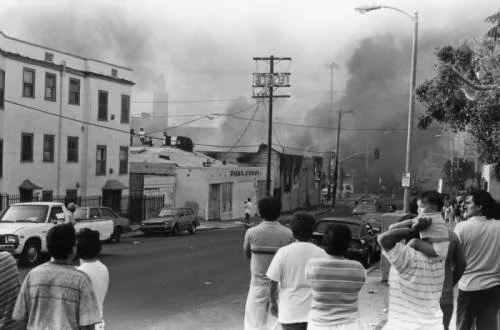
L.A. burning during 1992 riots | 1992 - Gary Leonard | Buildings going up in smoke on an unidentified street, April 30, 1992, as people watch | Los Angeles Photographers Photo Collection via Tessa at the Los Angeles Public Library
By the late 1990s, the Society’s standing in the city’s civic life was formally recognized when the Los Angeles City Council named LACHS the official “Friends of the City Archives.” The Society has since sponsored and published two major academic reference works on Los Angeles history, and compiled an online database of past City Officials — now donated to the Office of the City Clerk, where it serves researchers, journalists, and curious citizens alike. The Society has also supported research and publication by outside scholars — including, in a characteristically broad-minded move, a book on the city’s sewerage system. No corner of Los Angeles history, it seems, was too unglamorous to deserve preservation.
By 2012, the Society’s civic stature was such that Councilmember Tom LaBonge filed a motion urging that LACHS be given a permanent home in or near City Hall — ideally in the Los Angeles Mall, where it could serve the millions of tourists and residents who pass through downtown each year. It was a fitting tribute to what Mason, de Falla, and Parisi had built — an organization that had grown from a $7.50 membership fee and a borrowed meeting room into an institution the City of Los Angeles considered essential enough to want at its very center.
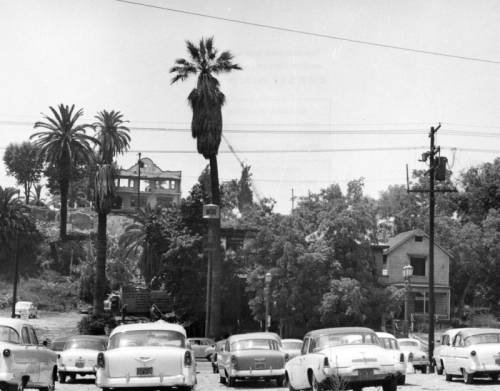
Bunker Hill demolition | 1957 - Security Pacific National Bank Photo Collection | via Tessa Los Angeles Public Library
Los Angeles is a city famously accused of having no memory — a metropolis so consumed by reinvention that it perpetually forgets what came before. William Mason, Paul de Falla, and Dr. Atilio Parisi refused to accept that characterization. They believed that Los Angeles had a deep and rich history worth knowing, a multi-ethnic founding story worth celebrating, and a civic identity worth protecting.
The institution they built in 1976 has outlasted all three of them. It continues to host lectures, support research, and advocate for the preservation of the city’s documentary heritage. Every plaque at the original Pueblo corners, every lecture in Marie Northrop’s name, every page of the City Officials database — these are the fingerprints of three men who loved their city enough to spend their lives remembering it for everyone else.
That, in the end, is the best kind of legacy a historian can leave.
The Los Angeles City Historical Society turns fifty this October, and the story of this city is still being written.
If reading about Mason, de Falla, and Parisi has stirred something in you — a memory, a family connection, a story your grandparents told about old Los Angeles — the Society wants to hear it. Tag posts about “Your Los Angeles History” on social media with #LACityHistory. That is, after all, exactly why these three men built it.
Membership is open to anyone who believes that Los Angeles deserves to be remembered, and the Society's doors, programs, and lectures are a living invitation to be part of that effort. Visit lachs.org to join, and if this article resonated with you, share it — because every person who reads it is one more Angeleno who knows where their city came from.
LACHS News
To offer you more value and a more interactive space, we’re now publishing on Substack. Head over to LACHS Substack to see our latest posts and join the conversation.
Find us back at the LA Times Festival of Books for our second annual appearance! We’ll be stationed at booth 046 in Cardinal Alley all weekend long—come say hello.
Sources: Los Angeles City Historical Society; Los Angeles County Museum of Natural History archives; William Mason photograph collection, Little Tokyo Historical Society; Chinese Historical Society of Southern California (Wikipedia/chssc.org); City of Los Angeles City Council Resolution, 35th Anniversary of LACHS, October 26, 2011; Motion by Councilmember Tom LaBonge re: LACHS Permanent Home, September 18, 2012; “William M. Mason, 69; Curator Explained L.A.’s Multiethnic Roots,” Los Angeles Times, November 25, 2000.
Bibliography
Primary Sources
City of Los Angeles City Council. “Resolution: Los Angeles City Historical Society 35th Anniversary.” Adopted October 26, 2011. Los Angeles City Clerk Online Document System. https://cityclerk.lacity.org/onlinedocs/2011/11-0004-S3_RESO_10-26-11.pdf
LaBonge, Tom (Councilmember, 4th District). “Motion re: Los Angeles City Historical Society Permanent Home.” Filed September 18, 2012. Los Angeles City Clerk Online Document System. https://cityclerk.lacity.org/onlinedocs/2011/11-2101-S1_MOT_09-18-12.pdf
Mason, William M. “L.A.’s Multiethnic Roots.” Op-ed. Los Angeles Times, September 4, 1975.
Legal Records
People v. Barnhart, 66 Cal. App. 2d 714 (1944). California Court of Appeal, Second District, Division One. November 6, 1944. [Establishes Paul de Falla as Deputy Sheriff of Los Angeles County and expert witness on bookmaking operations.]
Obituaries and Biographical Sources
“William M. Mason, 69; Curator Explained L.A.’s Multiethnic Roots.” Los Angeles Times, November 25, 2000. https://www.latimes.com/archives/la-xpm-2000-nov-25-me-57012-story.html
Newspaper Archives
"Graduation at Branch Friday." [Los Angeles newspaper, c. 1922–1923.] Reports election of First Grizzly class alumni officers, naming Atilio Parisi as treasurer. University of California Southern Branch (now UCLA).
Institutional Sources
Los Angeles City Historical Society. “History of the Society.” lachs.org. Accessed 2026.
Chinese Historical Society of Southern California. “Mission and History.” chssc.org. Accessed 2026. https://chssc.org/mission-and-history/
“Chinese Historical Society of Southern California.” Wikipedia. Accessed 2026. https://en.wikipedia.org/wiki/Chinese_Historical_Society_of_Southern_California
Archival Collections
William Mason Photograph Collection (Little Tokyo, 1960s). Little Tokyo Historical Society / Los Angeles County Museum of Natural History. Approximately 500 negatives and 162 prints.
Los Angeles County Museum of Natural History, Seaver Center for Western History Research. Records related to William M. Mason, Curator of Southern California History.
Published Works by William M. Mason
Adobe Interiors of Spanish California. Los Angeles: Los Angeles County Museum of Natural History.
The Census of 1790: A Demographic History of California.
Early Dominguez Families and Settlement of the Rancho San Pedro.
Japanese of Los Angeles.
Mason, William M., with Lowell Bean. The Romero Expeditions.
Mason, William M., with Donald Chaput and David Zarate. Modest Fortunes.
Mason, William M. “America’s Black Heritage” (exhibition, local sections). Los Angeles County Museum of Natural History, 1969.


